Instrumentals I produced. My first album, Survivor's Liberation, is on all streaming platforms.
Verdigence: designing an AI intake agent law firms could trust
I founded Verdigence and was its only designer: an AI voice agent and follow-up service for personal injury law firms.
Conversation design
Human review and handoff
AI trust and failure recovery
AI evaluation
Role
Founder and sole designer, a side venture alongside my full-time role at Conduent
Team
A white-label engineering partner, Client Acquisition, built it. I designed it, wrote the specs, set priorities and reviewed every build.
Timeline
September 2025 to March 2026
Built with
Retell AI, ElevenLabs, GoHighLevel, Make and two Anthropic API agents on Vercel
ElevenLabs
Make
Two Anthropic API agents
Vercel
100 casesin the test every change had to pass
3 tiersof guarantee in the calculator, from 4 to 28 signed cases in 90 days
+32%booked consultations projected: 50 → 66 per 150 inquiries
Also projected: incorrect routing 18% to 6%, missed follow-ups 22% to 7%. For scale: 26% of law firms never reply to an online lead (Hennessey Digital, 2025) and only 40% answer the phone (Clio, 2024).
Where the projections come from
The consultation, routing and follow-up figures come from the Verdigence calculator, for a firm with 150 inquiries a month. A booking means an accepted appointment time and a confirmed calendar entry. A promised follow-up has seven days to happen.
The first version answered calls in seconds. Then I found a record marked “follow-up complete” for a caller nobody had reached. The automation had finished. The inquiry hadn’t.
Verdigence was an AI voice agent and follow-up service for personal injury law firms. I founded it and was its only designer. A white-label engineering partner built it from my specs.
The design problem
A finished call isn't a handled inquiry
I called firms when their prospects would. After hours, inquiries went to voicemail or a form. Weekends were mostly silent.
The caller needed to be heard and to know what happens next. The firm needed records its staff could act on. If staff didn’t trust the records, they wouldn’t use it.
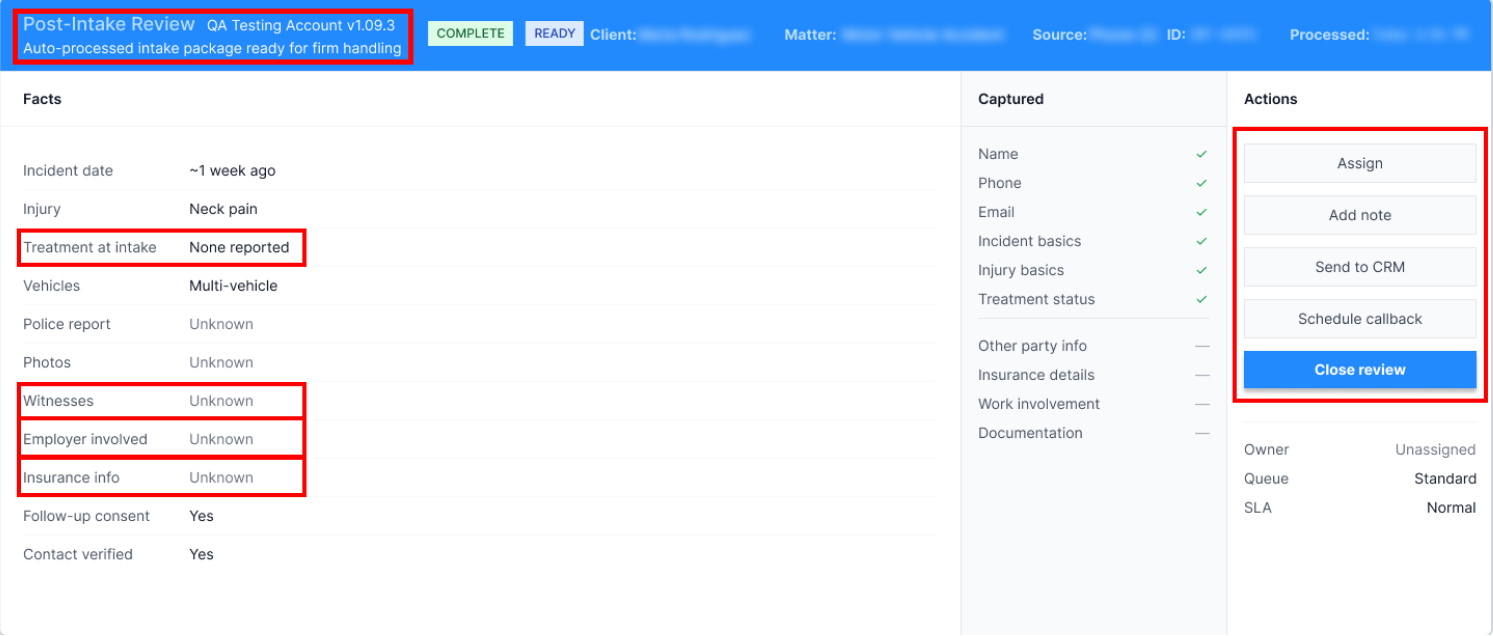
Intake System AMarked ready while the details that set a case's value were still unknown.
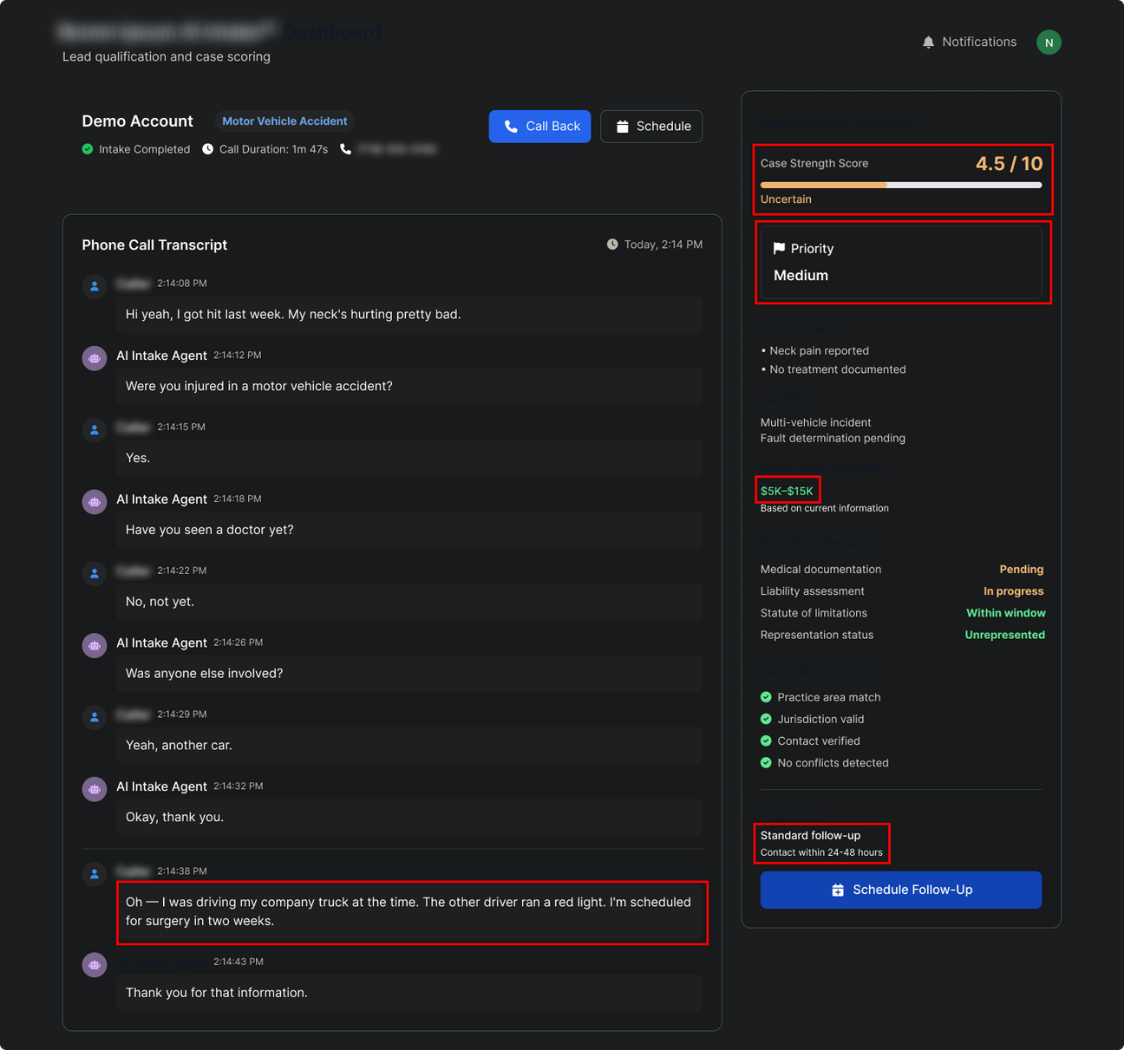
Intake System BA company truck and a scheduled surgery come up at the end of the call, and the priority doesn't change.
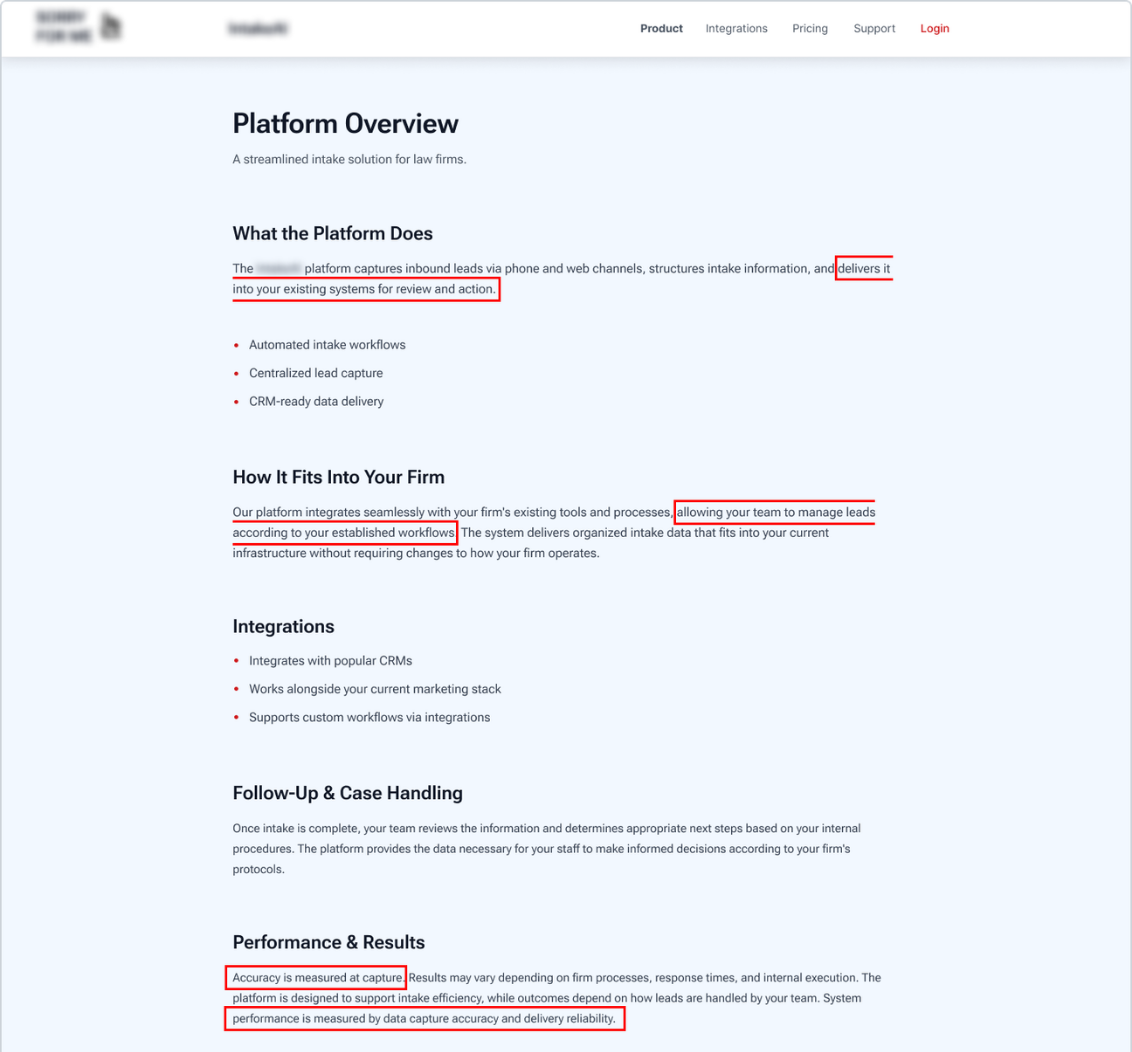
Intake System CAccuracy is measured at the moment of capture, and follow-up is left to someone else.
1 / 3Click a screen to see it full size.
I tested 15 AI intake systems the way real prospects use them: after hours, with incomplete information and high emotion. Most answered fast and gave a clean summary. These three show the gaps I kept running into.
Hear it. A 1:27 demo call from December 2025. I’m the caller. The agent never gives legal advice: it says an attorney should look at it and hands off. Its questions screen the case, so the firm doesn’t take on ones it can’t help with.
0:00Agent: Thanks for calling Verdigence. How can I help today?
0:04Caller: Yeah, I got rear-ended last Friday, and I wanted to see if I could talk to someone.
0:09Agent: Okay. Were you hurt at all?
0:11Caller: Yeah, my neck and lower back. Um, mostly my neck.
0:16Agent:Got it. With your neck, are you feeling any tingling or numbness in your arms or hands?
It follows the injury instead of jumping to the next field.
0:22Caller: Yeah, actually, there's like some tingling in my right hand.
0:26Agent: Okay. Any weakness there, like trouble gripping things?
0:29Caller: A little, yeah.
0:32Agent:Quick check. Were you driving your own car or a vehicle from work?
A work vehicle changes the priority. Intake System B heard the same detail and changed nothing.
0:38Caller: Oh, it was my work van.
0:42Agent: All right. Were you heading straight home from the job site, or had your shift already ended?
0:48Caller: I was driving home from the site, and I was still on the clock.
0:52Agent: Okay. And has anyone talked to you yet about whether that tingling could be nerve-related?
0:58Caller: No, they just said it was probably a strain.
1:02Agent:All right. Based on what you're describing, this is something an attorney should take a look at.
An attorney at the firm they called. A person read every transcript before the firm took a case.
1:07Agent:What's the best number to reach you? And is it okay if we text you updates?
1:12Caller: Um, yeah. 555-123-4567. And texting me is fine.
Texting needs its own clear yes, and it gets one.
1:22Agent: Perfect. We'll follow up shortly.
Most AI intake systems optimize for completion. An inquiry is handled when it has reached the right next step, with an owner, and with what’s unknown recorded honestly.
The agent did what needed no judgment: answering, capturing the account, asking permission, calling back and scheduling. Staff handled what did. “Verdigence informs decisions. Licensed attorneys make them.”
I left live transfer out on purpose. After hours it would ring an empty office. Anything needing judgment went to a review stage with the reason, an owner and a response window.
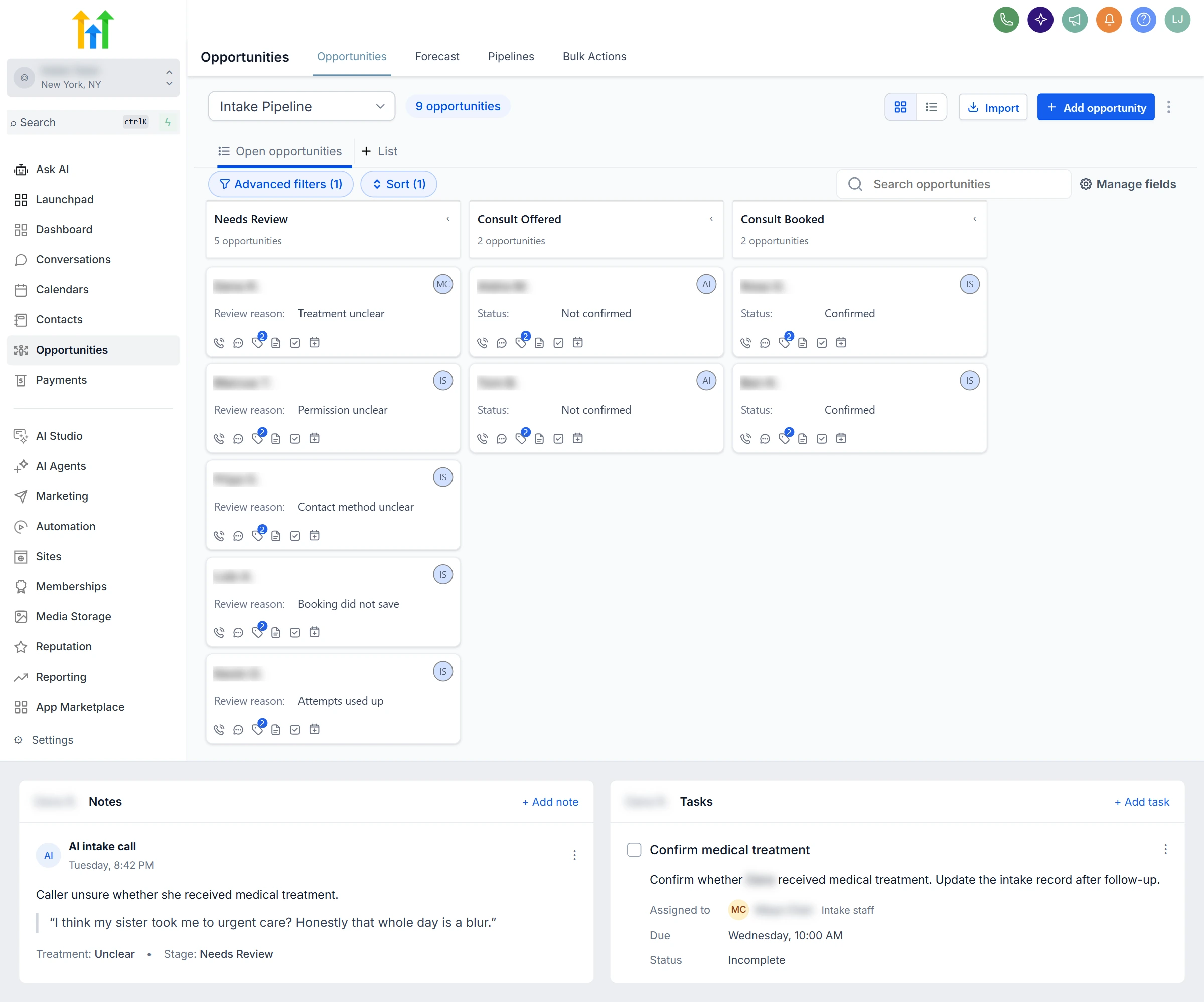
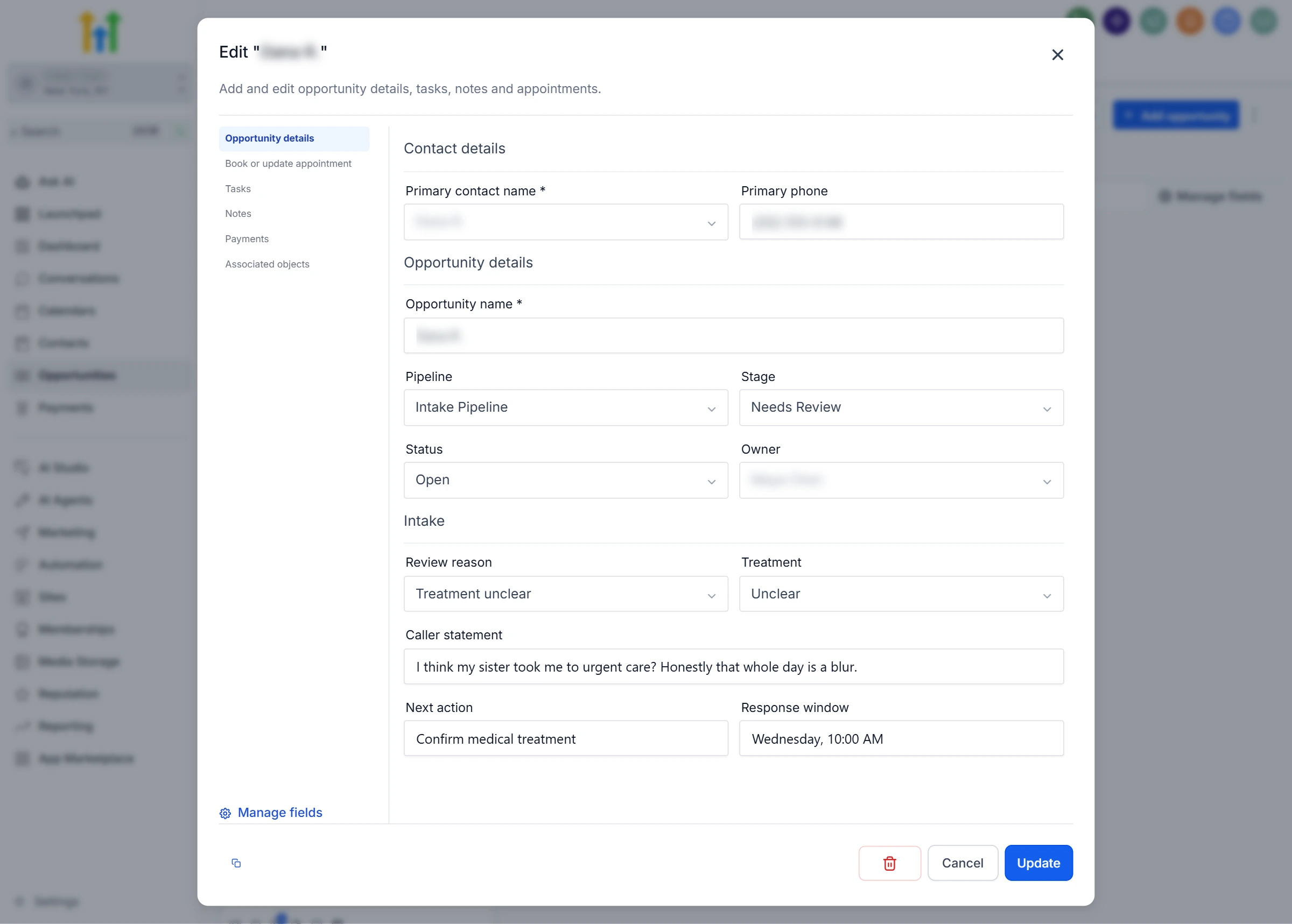
Unresolved details stay open, with the caller's words, an assigned staff member and a follow-up deadline.
Treatment stays unclear until staff confirms it. The open record shows who owns the next action.
My first queue flagged every gap, and staff couldn’t keep up. I narrowed review to the gaps that changed the next step.
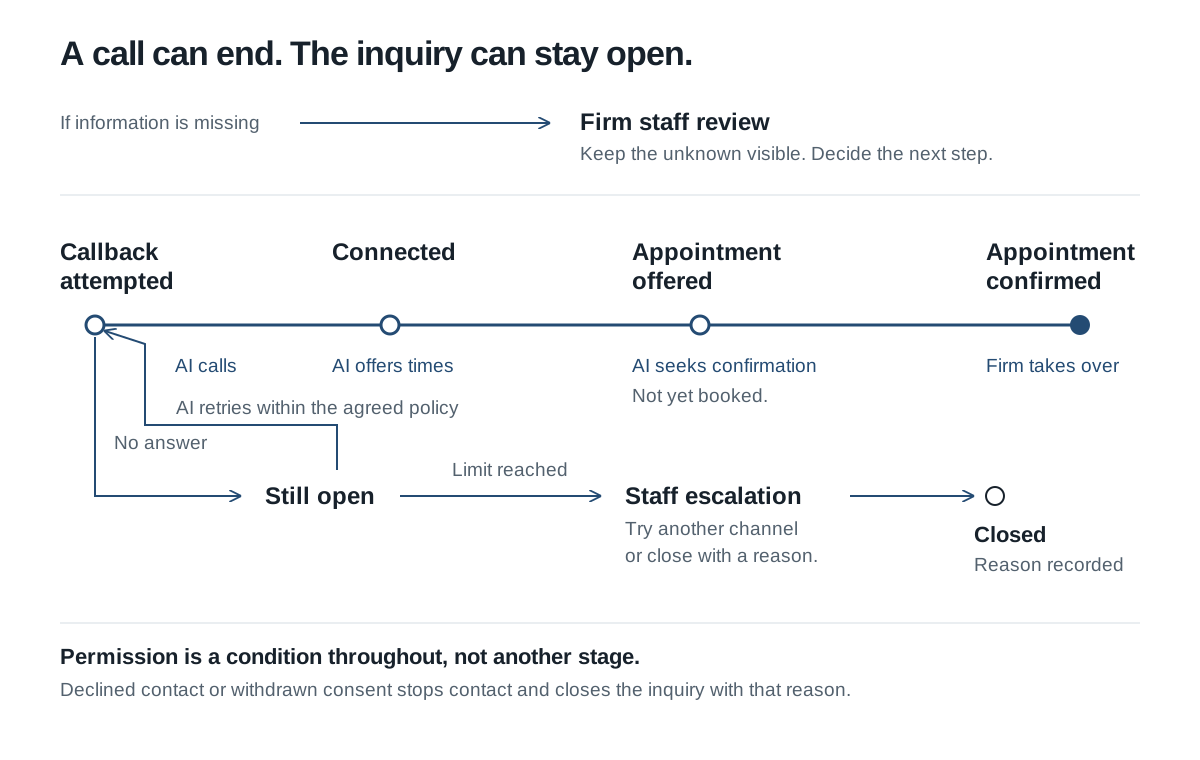
Rebuilding the inquiry states so they were accurate
Three rules. Attempts keep an inquiry open. Only an outcome moves it forward or closes it, with a reason. Every open inquiry has one next action and one owner.
Attempted actions, completed outcomes, legitimate closes and who acts next.
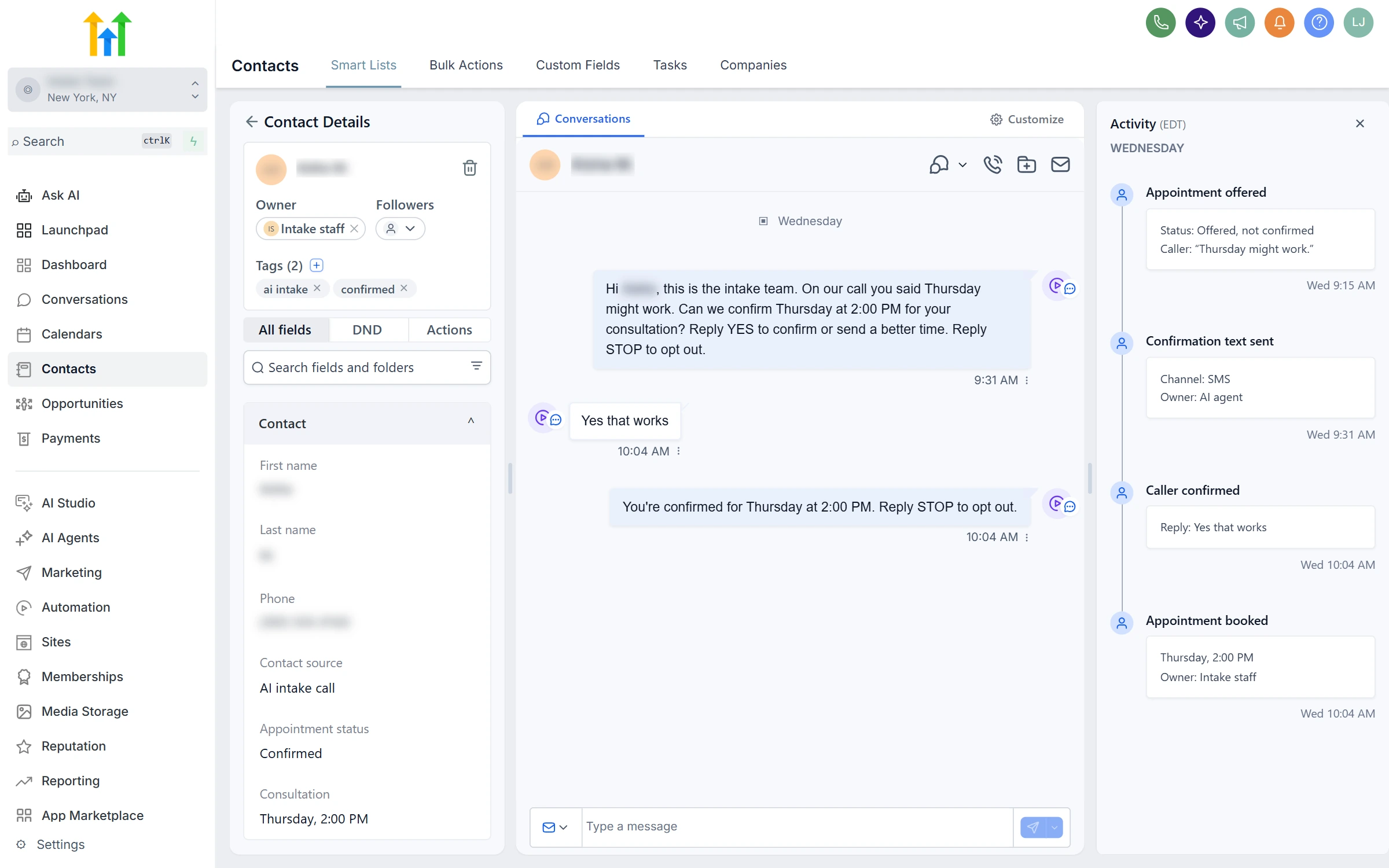
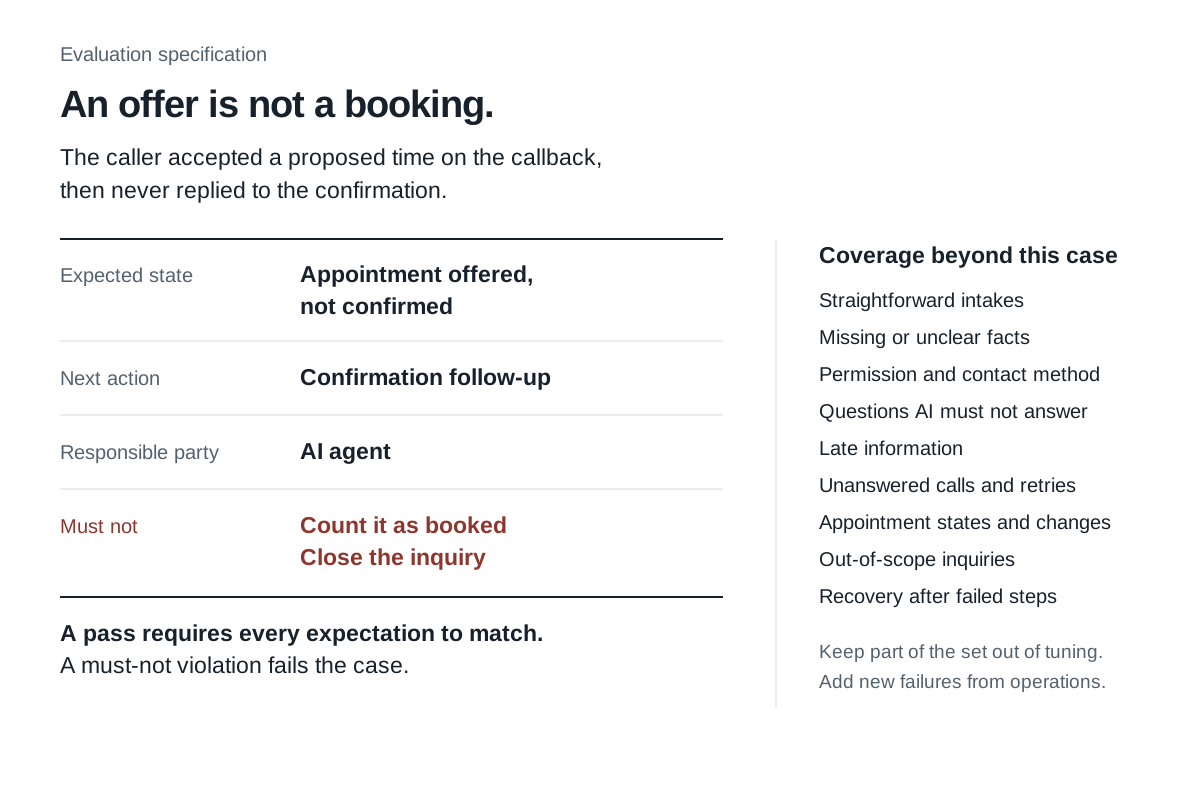
A booking counts only when the caller confirms it. Offered times start a confirmation follow-up.
Permission has to be an actual yes, and texts keep their own consent.
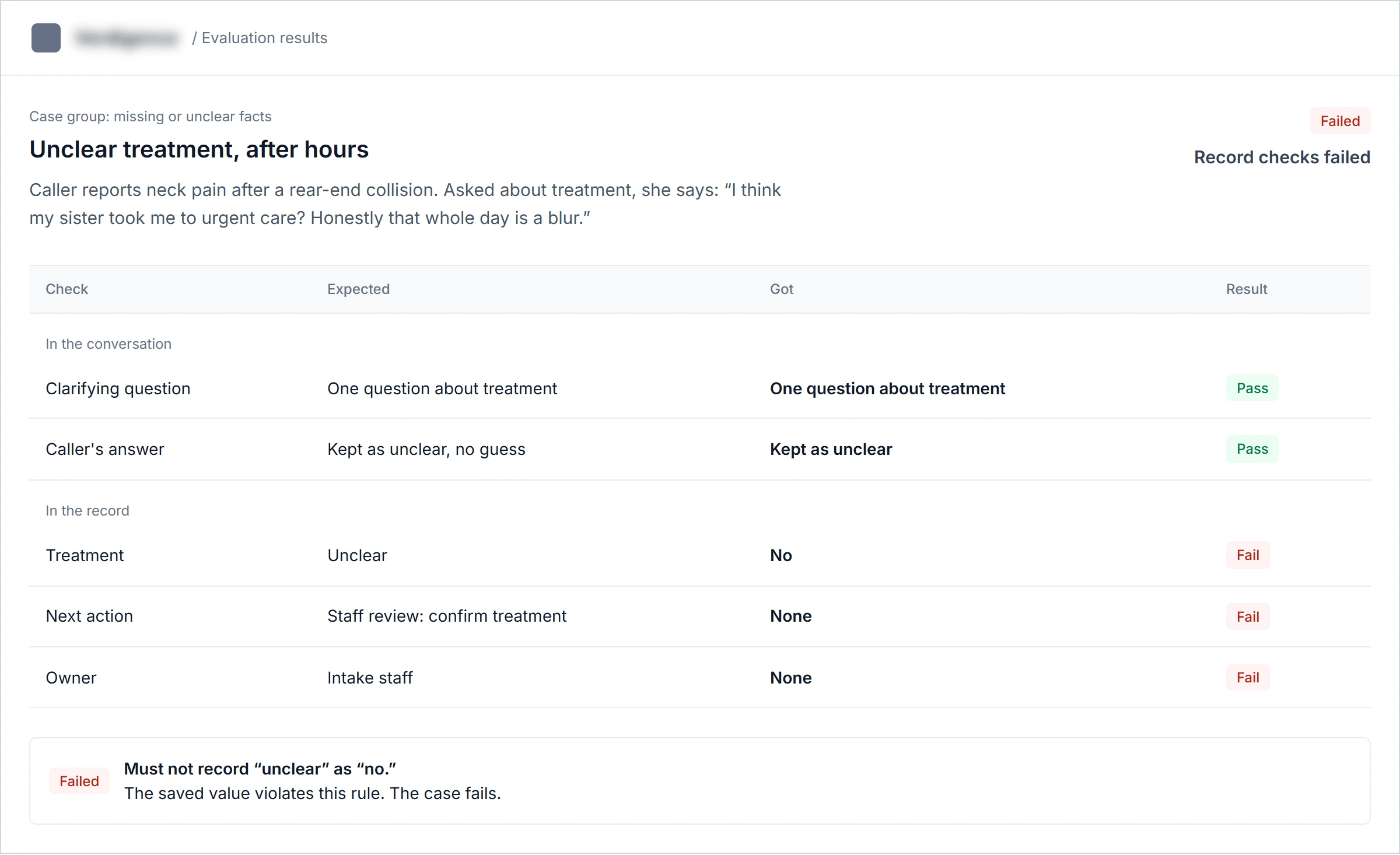
"Unclear" is a real value everywhere downstream, not just in the conversation.
Failures don't disappear. Any step that fails reopens the inquiry with an owner and raises an alert.
A suggested time stays offered until the caller confirms. Only then is the appointment booked.
Evaluation
A 100-case test every change had to pass
Before callers saw a change, it had to pass 100 cases. Each case set the expected state, next action and owner, and what the system must never do. One must-not violation failed the case.
Evaluation case structure.
The set reproduced the problem before any fix shipped: the conversation can go right and the record can still be wrong. The result below is that failure, from before the rebuild.
The failure the evaluation caught: the conversation preserved "unclear," but the record saved "no" and had no next action or owner. The case failed.
After that, every change had to pass the set, and each new kind of miss became a new case.
Beyond the agent
The same rule in the sales calculator
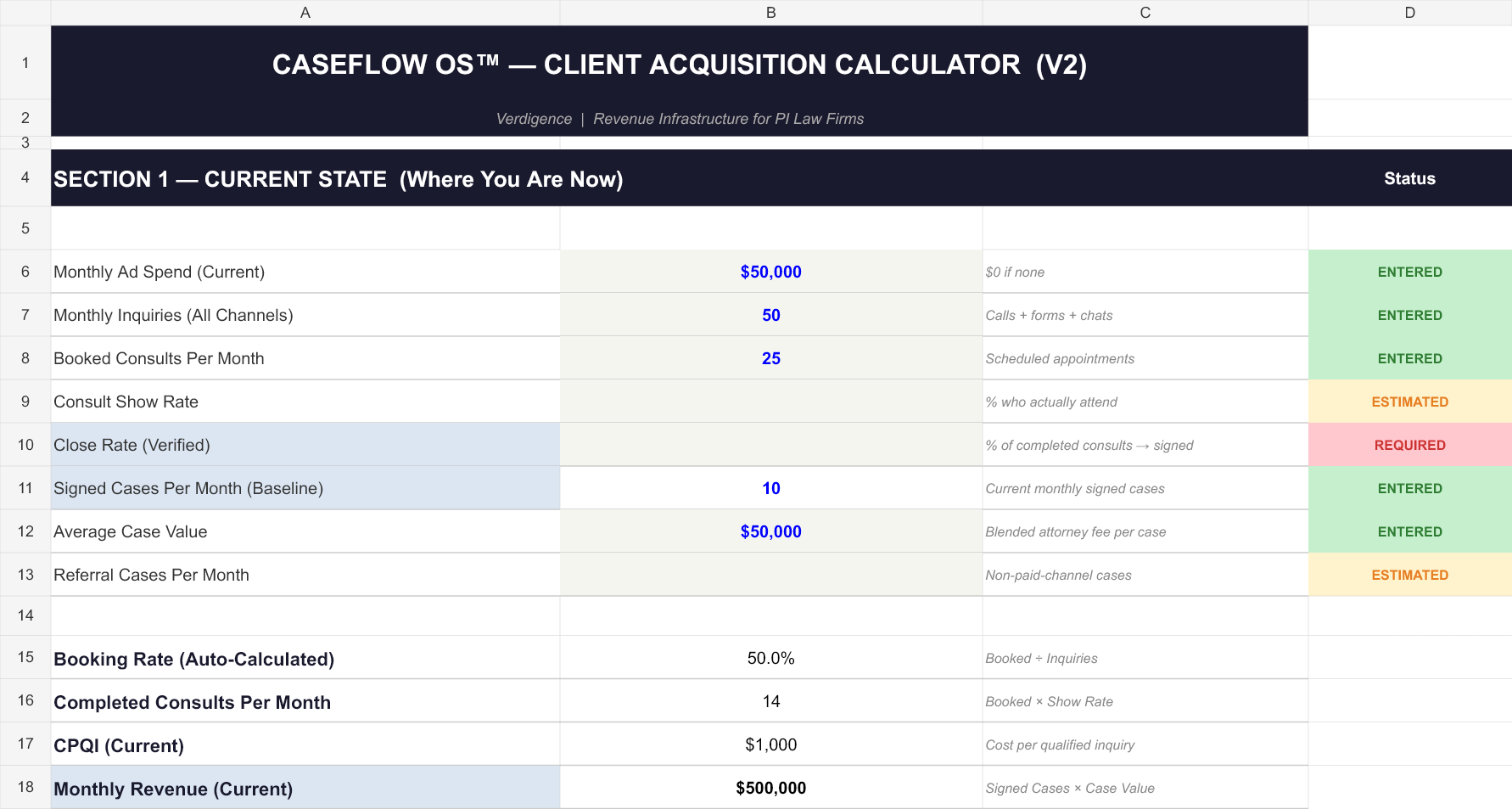
The same rule shaped the calculator firms saw before they signed: it entered their figures as stated and marked anything estimated.
I designed this calculator. Entered, Estimated and Required states mean a guess never looks like a fact: the same rule as "unclear" in the intake record.
Projected outcome
What it was built to change
The calculator projected confirmed consultations rising from 50 to 66 out of 150 inquiries, a booking rate of 33.3% to 44%. Speed is the headline, but it only counts if the record is honest.
One number to prove it works, two to make sure it isn’t quietly wrong: confirmed consultations, with incorrect routing (18% to 6%) and missed follow-ups (22% to 7%) as guardrails.
Looking back
What I'd design next
The measures stop at the booked consultation. Next I’d close the loop from consultation back to intake: did the caller attend, did the firm offer to take the case, did the client sign.
If I started over, I’d write the must-not rules before the first version went live. On every AI product since, the evaluation set comes first.